
Mohanna Leads the First Risk-Sharing Simulation Workshop for Yemen’s Humanitarian Response
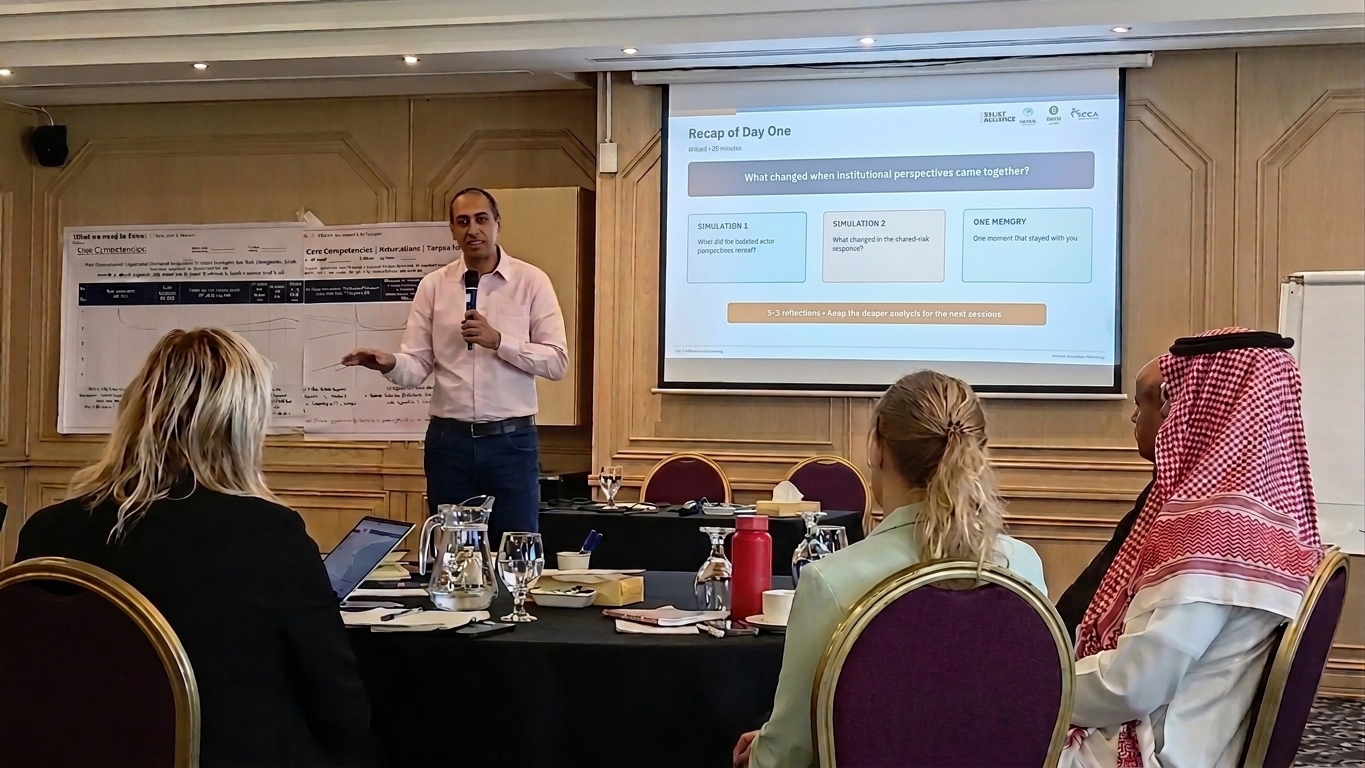
On 7–8 September 2026, I had the privilege of designing and leading the first Risk-Sharing Simulation Workshop for Yemen’s humanitarian response in Amman, Jordan.
The two-day workshop brought together 26 representatives from donor institutions, international NGOs, national NGOs and government institutions. It was convened by the Yemen Family Care Association (YFCA), in collaboration with the partners of the HST-LHL Risk Sharing Technical Working Group—Oxfam, the Dutch Relief Alliance and the Response Innovation Lab—and in coordination with the DRA–Yemen Joint Response.
Moving from theory to practice
Risk sharing is frequently discussed within the humanitarian sector, but it can remain difficult to translate into practical decisions, responsibilities and actions.
The workshop was therefore designed as a simulation rather than a conventional training. Participants worked through a fictional humanitarian response covering the full programme cycle—from understanding the context and identifying risks to planning, implementation, mitigation, escalation and follow-up.
Place it under “Moving from theory to practice,” after the paragraph ending with “mitigation, escalation and follow-up.”
To support the exercises and capture the evidence consistently, we used two purpose-built digital tools. The Risk Sandbox was used during the siloed exercises to record and organize the risks identified by each institutional group, while the Risk Sharing Platform supported the shared exercise by capturing preventive and reactive measures, responsibilities and follow-up actions. Both tools were used by the facilitation team within controlled, password-protected environments.
During the first simulation, donors, international NGOs and national NGOs worked separately according to their institutional roles. In the second, they worked in mixed groups to analyse the same types of risks together.
This structure allowed us to examine what changes when different actors move from managing risks within institutional silos to discussing them collectively.
What changed when actors worked together?
The clearest difference was not simply the number of risks or actions recorded. It was the quality of the conversation.
Mixed-group discussions brought together operational knowledge, funding perspectives, compliance considerations and decision-making authority. Participants were better able to question assumptions, identify dependencies and distinguish between preventive measures and the actions required if a risk materialized.
Responsibilities also became more explicit. The discussions showed that meaningful risk sharing cannot be achieved merely by including several organizations in a meeting or response plan. Responsibilities must reflect each actor’s authority, influence, resources and practical ability to manage the risk.
The barriers that remained visible
Participants identified five clusters of persistent barriers—described during the workshop as the “elephants” in risk sharing:
- Overwhelming workloads and timing pressures
- Fear of exposure and limited openness
- Gaps in resources, capacity and awareness
- Missing mechanisms and unclear ownership
- Unequal power, authority and commitment
These barriers help explain why risks often remain concentrated among the actors closest to implementation, even when decisions and resources sit elsewhere in the humanitarian delivery chain.
What would make risk sharing work better?
The workshop identified several practical enabling conditions:
- Regular and safe multi-actor risk dialogue
- Simple mechanisms for recording priorities, responsibilities and decisions
- Stronger institutional understanding and practical capacity
- Clear ownership and decision-making rights
- Resource flexibility proportionate to the responsibilities assigned
Participants also developed four advocacy messages calling for regular risk-sharing discussions, dedicated support for capacity and awareness, practical tools for sharing risks, and safe spaces where concerns can be raised without fear of judgement.
These messages reflect the priorities expressed during the workshop. They are propositions for further discussion and validation, rather than formal commitments by participating organizations.
A foundation for continued dialogue
The simulation demonstrated that bringing different actors together can broaden the understanding of risks and generate more practical response options. However, participation alone does not mean that responsibility has been shared.
Meaningful risk sharing requires transparency about who holds authority, who controls resources, who can act, and where the remaining exposure ultimately sits when a risk cannot be fully mitigated.
I am grateful to all participants, facilitators and partner organizations whose openness and experience made this exercise possible. The findings provide a valuable evidence base for continued dialogue on strengthening risk sharing across Yemen’s humanitarian response.
Click the button below to fill out the form and subscribe to Mohanna.io's newsletter.
Fill the Subscription Form